News & Info
The Mother Sauces of Fundraising Data
04/02/2026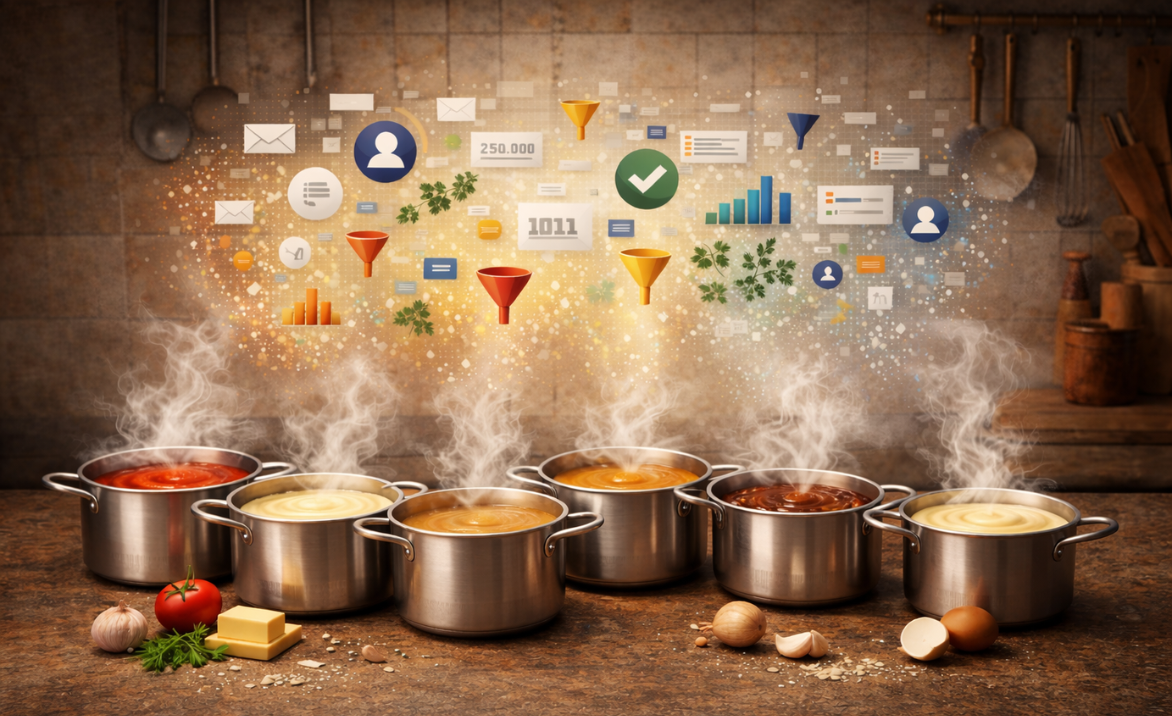
By Tom Hutchison, VeraData
French cooking runs on six mother sauces. Béchamel, Velouté, Espagnole, Tomato, Hollandaise, and Mayonnaise. Every other sauce in the canon is derived from one of these. Fundraising data works the same way. A chef who understands the five can improvise endlessly. A chef who doesn’t is just following recipes.
There are really only a handful of source types that power every donor acquisition campaign in the nonprofit sector. The names get dressed up differently depending on who’s selling them, but the ingredients are the ingredients. Here’s what’s actually in the pot.
Béchamel: The Co-Op. Nonprofits contribute donor information into a shared pool. The operator models the combined data and delivers ranked names most likely to respond to your appeal. Co-ops are the workhorse of nonprofit acquisition — good volume, lower CPMs than list rentals, and modeling that gets smarter as more organizations participate. The limitation is that most co-ops still run on RFM (recency, frequency, monetary value), which tells you what a donor did but not why they did it.
Velouté: The List Broker. A broker connects you with individual donor or consumer lists for one-time rental. Good brokers know the market cold — which lists are hot, which owners negotiate, which audiences fit your profile. The trade-off is that each rented list gives you one data point. You know Jane Doe gives to the National Wildlife Federation. You don’t know much else unless you pay to append it.
Espagnole: The List Exchange. You share your donor list with another organization, they share theirs with you, usually at minimal cost. The appeal is relevance — you’re getting proven donors from adjacent causes. The trap is the illusion of freshness. The same names circulate across the sector year after year, and most organizations hold back their best donors. You think you’re getting new names. Often you’re just swapping familiar ones.
Tomato: Compiled Data. Census records, property filings, vehicle registrations, consumer surveys — compiled databases profile virtually every household in the country. The scale is enormous. The blind spot is that compiled data has no giving behavior. It can tell you a household earns $150,000 and has an interest in wildlife. It can’t tell you that person gave $50 to three animal welfare organizations last December. That behavioral signal is the difference between a name and a donor.
Hollandaise: Fundraising Data. Hollandaise is the temperamental one — an emulsion that demands precision and falls apart without it. Fundraising data is a combination of data sources that provide more utility than those sources do by themselves. We use combinations of data to create our Wealth Index to identify people with the resources to make large gifts. We use transaction data to determine how people like to give. And we use response and opt out data to see when people have been engaged too much. These products are difficult for nonprofits to build because the data is unpredictable and volatile, much like a hollandaise.
Mayonnaise: Digital Data. The only cold mother sauce, mayonnaise, is different. Much like digital data which cannot always be resolved to an individual. All of the other data sources come with name and address information which allows us to recognize each unique person. Digital data can often be tracked to a segment or a campaign, but the blend of data from digital and traditional channels creates a more complex saveur that improves the fundraising outcome.
Haute Cuisine: Donor Science. At VeraData, Donor Science is our framework for the interplay of data that comes together to create beneficial outcomes. Like French haute cuisine, it is based on well-known standards and practices. Chefs know what people like, just as our strategists know how people behave. Sauciers know how to make the mother sauces using fundamental ingredients, spices, and skill. Just as our analysts know how to predict donor behavior using data, machine learning and artificial intelligence.
We help you find responsive, cost effective audiences using our Donor Vision co-op and our list brokerage and exchange services. We develop a deeper understanding of donor behaviors using our compiled data products. Using transaction data we create the analytics to select profitable audiences and suppress people who are habitually no-responsive. Finally digital data, helps us understand how people engage through each interaction.
Most fundraisers have used all of these sources at some point. Fewer have stopped to think about what each one can and can’t tell you. The co-op knows behavior but not depth. The broker knows names but not context. The exchange knows relevance but recycles the same pool. Compiled data knows demographics but not generosity.
The mother sauces built French cuisine into a tradition worth studying. Knowing what’s in yours is how you start cooking with intention.
If your fundraising kitchen could use a better recipe, we know a few.