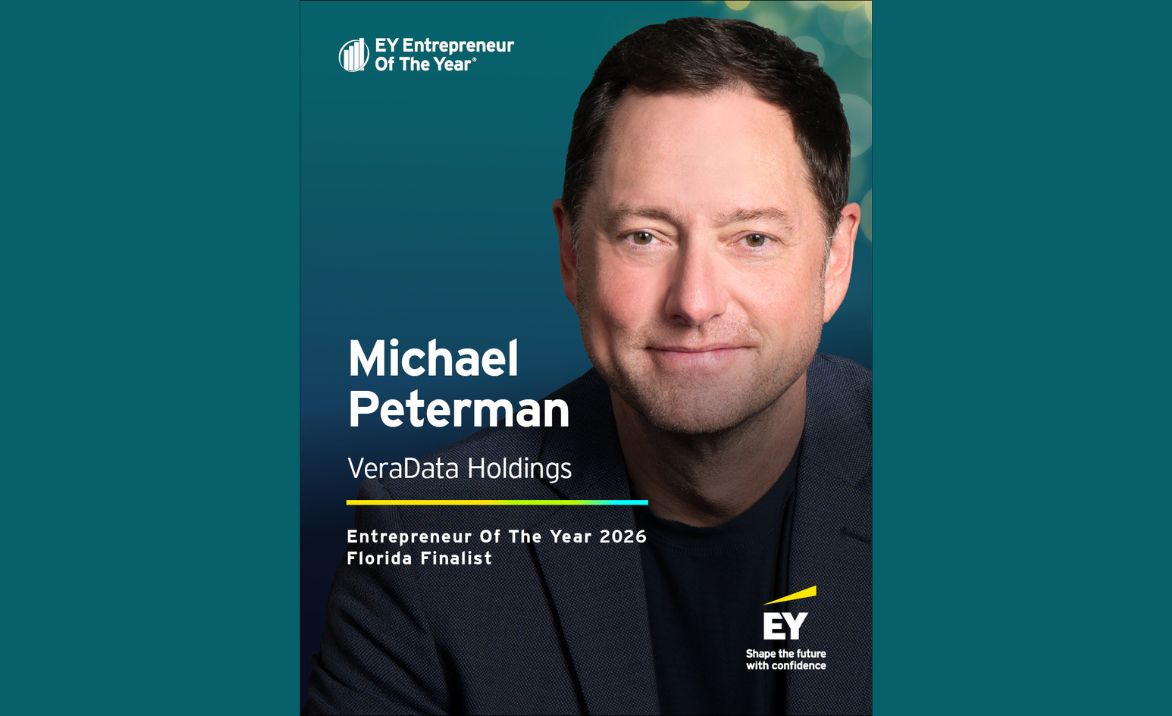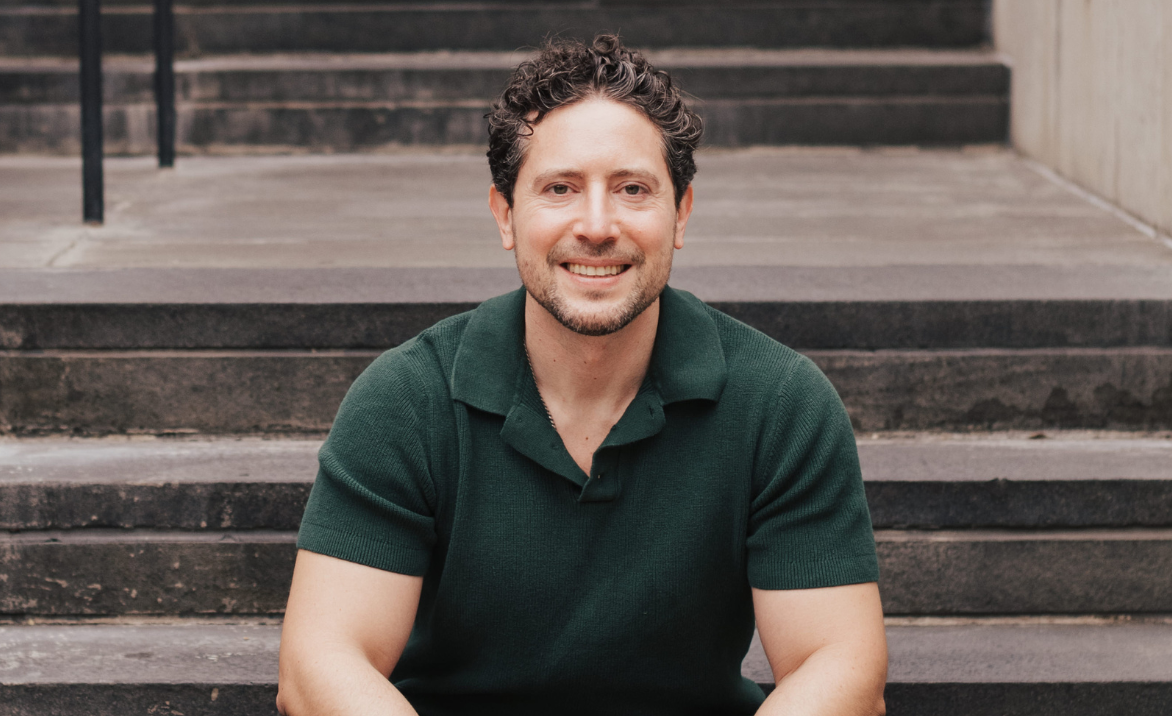
Michael Peterman of VeraData named Entrepreneur Of The Year® 2026 Florida Finalist By EY US

 EY US celebrates ambitious entrepreneurs shaping the future of business.

MIAMI, April 21, 2026 – Michael Peterman, founder and CEO of VeraData Holdings (“VeraData”), has today been named a finalist for the Entrepreneur Of The Year 2026 Florida Award by Ernst & Young LLP (EY US). Now in its 41st year, the Entrepreneur Of The Year program celebrates the bold leaders who disrupt markets through the world’s most ground-breaking companies, revolutionizing industries and uplifting communities. The program honors entrepreneurs whose innovations drive economic growth and help shape the future of business.

An independent panel of judges selected Peterman among 35 finalists based on their entrepreneurial spirit, purpose, company growth and lasting impact in building long-term value.

“Being named a finalist for Entrepreneur Of The Year is an incredible honor, not just for me, but for the entire VeraData team,” said Michael Peterman, founder and CEO of VeraData. “We built this company on the belief that data science, done right, can transform the way nonprofits connect with donors and sustain their missions. This recognition reflects what’s possible when you combine deep expertise with a genuine commitment to the sector, and I’m grateful to every client, partner, and team member who’s been part of that journey.”

Entrepreneur Of The Year honors business leaders for their ingenuity, courage and entrepreneurial spirit. The program celebrates original founders who bootstrapped their business from inception or who raised outside capital to grow their company, transformational CEOs who infused innovation into an existing organization to catapult its trajectory, and multigenerational family business leaders who reimagined a legacy business model to strengthen it for the future.

This year’s Florida finalists represent many industries, including technology, consumer products, manufacturing, finance and more. Michael has spent 20 years actually building in this space, not just talking about it. He’s the first founder in the nonprofit data and fundraising services sector to earn this recognition.

Regional award winners will be announced on June 12 during a special celebration in Miami and will become lifetime members of an esteemed community of Entrepreneur Of The Year alumni from around the world. The winners will then be considered by the national judges for the Entrepreneur Of The Year National Awards, which will be presented in November at the annual Strategic Growth Forum®,  where high-growth CEOs, Fortune 1000 executives and investors converge to shape the future of business.

About VeraData

VeraData is the originator of Donor Science™, pioneering the use of AI, machine learning, and behavioral data to help nonprofits acquire more donors and generate more revenue. VeraData blends Donor Science, Creative Science, and Media Science through its partner agencies Teal Media (creative and digital storytelling) and Faircom New York (integrated fundraising strategy and donor communications). With capabilities spanning predictive analytics, creative strategy, direct mail production, and data-driven optimization, VeraData equips mission-driven organizations to turn insights into impact and achieve stronger fundraising results. For more information, visit VeraData.com.

About Entrepreneur Of The Year®

Founded in 1986, Entrepreneur Of The Year® has celebrated more than 11,000 ambitious visionaries who are leading successful, dynamic businesses in the US, and it has since expanded to nearly 80 countries and territories globally.

The US program consists of 17 regional programs whose panels of independent judges select the regional award winners every June. Those winners compete for national recognition at the Strategic Growth Forum® in November where national finalists and award winners are announced. The national overall winner represents the US at the World Entrepreneur Of The Year® competition. Visit ey.com/us/eoy.

About EY

EY is building a better working world by creating new value for clients, people, society and the planet, while building trust in capital markets.

Enabled by data, AI and advanced technology, EY teams help clients shape the future with confidence and develop answers for the most pressing issues of today and tomorrow. 

EY teams work across a full spectrum of services in assurance, consulting, tax, strategy and transactions. Fueled by sector insights, a globally connected, multi-disciplinary network and diverse ecosystem partners, EY teams can provide services in more than 150 countries and territories.

All in to shape the future with confidence. 

EY refers to the global organization, and may refer to one or more, of the member firms of Ernst & Young Global Limited, each of which is a separate legal entity. Ernst & Young Global Limited, a UK company limited by guarantee, does not provide services to clients. Information about how EY collects and uses personal data and a description of the rights individuals have under data protection legislation are available via ey.com/privacy. EY member firms do not practice law where prohibited by local laws. For more information about our organization, please visit ey.com.

Sponsors

Founded and produced by Ernst & Young LLP, the Entrepreneur Of The Year Awards include presenting sponsors PNC Bank, Cresa, LLC, Marsh USA, SAP, and the Ewing Marion Kauffman Foundation. In Florida, sponsors also include ADP and Selective Insight– regional Silver sponsors.

Media Contact:
Joey Mechelle Farqué, Head of Content, jfarque@veradata.com

The Mother Sauces of Fundraising Data

By Tom Hutchison, VeraData

French cooking runs on six mother sauces. Béchamel, Velouté, Espagnole, Tomato, Hollandaise, and Mayonnaise. Every other sauce in the canon is derived from one of these. Fundraising data works the same way. A chef who understands the five can improvise endlessly. A chef who doesn’t is just following recipes.

There are really only a handful of source types that power every donor acquisition campaign in the nonprofit sector. The names get dressed up differently depending on who’s selling them, but the ingredients are the ingredients. Here’s what’s actually in the pot.

Béchamel: The Co-Op. Nonprofits contribute donor information into a shared pool. The operator models the combined data and delivers ranked names most likely to respond to your appeal. Co-ops are the workhorse of nonprofit acquisition — good volume, lower CPMs than list rentals, and modeling that gets smarter as more organizations participate. The limitation is that most co-ops still run on RFM (recency, frequency, monetary value), which tells you what a donor did but not why they did it.

Velouté: The List Broker. A broker connects you with individual donor or consumer lists for one-time rental. Good brokers know the market cold — which lists are hot, which owners negotiate, which audiences fit your profile. The trade-off is that each rented list gives you one data point. You know Jane Doe gives to the National Wildlife Federation. You don’t know much else unless you pay to append it.

Espagnole: The List Exchange. You share your donor list with another organization, they share theirs with you, usually at minimal cost. The appeal is relevance — you’re getting proven donors from adjacent causes. The trap is the illusion of freshness. The same names circulate across the sector year after year, and most organizations hold back their best donors. You think you’re getting new names. Often you’re just swapping familiar ones.

Tomato: Compiled Data. Census records, property filings, vehicle registrations, consumer surveys — compiled databases profile virtually every household in the country. The scale is enormous. The blind spot is that compiled data has no giving behavior. It can tell you a household earns $150,000 and has an interest in wildlife. It can’t tell you that person gave $50 to three animal welfare organizations last December. That behavioral signal is the difference between a name and a donor.

Hollandaise: Fundraising Data. Hollandaise is the temperamental one — an emulsion that demands precision and falls apart without it. Fundraising data is a combination of data sources that provide more utility than those sources do by themselves. We use combinations of data to create our Wealth Index to identify people with the resources to make large gifts. We use transaction data to determine how people like to give. And we use response and opt out data to see when people have been engaged too much. These products are difficult for nonprofits to build because the data is unpredictable and volatile, much like a hollandaise. 

Mayonnaise: Digital Data. The only cold mother sauce, mayonnaise, is different. Much like digital data which cannot always be resolved to an individual. All of the other data sources come with name and address information which allows us to recognize each unique person. Digital data can often be tracked to a segment or a campaign, but the blend of data from digital and traditional channels creates a more complex saveur that improves the fundraising outcome.

Haute Cuisine: Donor Science. At VeraData, Donor Science is our framework for the interplay of data that comes together to create beneficial outcomes. Like French haute cuisine, it is based on well-known standards and practices. Chefs know what people like, just as our strategists know how people behave. Sauciers know how to make the mother sauces using fundamental ingredients, spices, and skill. Just as our analysts know how to predict donor behavior using data, machine learning and artificial intelligence. 

We help you find responsive, cost effective audiences using our Donor Vision co-op and our list brokerage and exchange services. We develop a deeper understanding of donor behaviors using our compiled data products. Using transaction data we create the analytics to select profitable audiences and suppress people who are habitually no-responsive. Finally digital data, helps us understand how people engage through each interaction. 

Most fundraisers have used all of these sources at some point. Fewer have stopped to think about what each one can and can’t tell you. The co-op knows behavior but not depth. The broker knows names but not context. The exchange knows relevance but recycles the same pool. Compiled data knows demographics but not generosity.

The mother sauces built French cuisine into a tradition worth studying. Knowing what’s in yours is how you start cooking with intention.

If your fundraising kitchen could use a better recipe, we know a few.

VeraData Names Omri Goldshtrom Senior Vice President of Product and Innovation

FOR IMMEDIATE RELEASE

Former Indeed and ActivTrak product executive joins the Donor Science Company to lead AI-driven product strategy for the nonprofit sector.

FORT MYERS, FL (April 2, 2026) — VeraData, The Donor Science Company, today announced the appointment of Omri Goldshtrom as Senior Vice President of Product and Innovation. Goldshtrom brings 17 years of product leadership experience, including nearly a decade in workforce intelligence at Indeed and ActivTrak, where he built predictive platforms focused on agentic AI and predictive modeling.

In his new role, Goldshtrom will oversee VeraData’s product roadmap and innovation strategy, applying his background in predictive modeling and AI to the nonprofit fundraising sector. His hire signals VeraData’s continued investment in the technology and talent behind donor science.

With more than 2 million nonprofits in the United States and charitable giving accounting for roughly 3% of GDP, the sector represents a significant and growing market for data-driven fundraising solutions. VeraData works with hundreds of nonprofit organizations across veteran causes, humanitarian aid, animal welfare, child health, and more, helping them identify and engage donors through advanced analytics and predictive modeling.

“Omri spent nearly a decade at Indeed and ActivTrak building predictive platforms that serve millions of users, and bringing that product discipline to the nonprofit data space, where the stakes are missions, is a big deal for our clients and for us,” said Matt Kaiser, Chief Strategy Officer. “We couldn’t be more excited to have him leading product and innovation.”

As the originator of Donor Science, VeraData has led the integration of AI, machine learning, and predictive modeling into nonprofit fundraising, serving more than 400 organizations and supporting over $1 billion in annual giving. Goldshtrom’s hire reflects the company’s continued investment in the leadership and technology behind that mission.

“After spending my career focused on how people work and find work, I’m shifting to how people give,” said Goldshtrom. “VeraData supports an incredible roster of nonprofit clients, and by leveraging agentic AI and predictive modeling, we aren’t just finding donors. We’re helping missions scale.”

###

About VeraData

VeraData is the originator of Donor Science™, pioneering the use of AI, machine learning, and behavioral data to help nonprofits acquire more donors and generate more revenue. VeraData blends Donor Science, Creative Science, and Media Science through its partner agencies Teal Media (creative and digital storytelling) and Faircom New York (integrated fundraising strategy and donor communications). With capabilities spanning predictive analytics, creative strategy, direct mail production, and data-driven optimization, VeraData equips mission-driven organizations to turn insights into impact and achieve stronger fundraising results. For more information, visit VeraData.com.

Media Contact: Joey Mechelle Farqué, Head of Content, jfarque@veradata.com

You’re Leaving Major Donor Money on the Table And Your Data Is Why

By Michael Black, VeraData

Remember Robin Leach’s Lifestyles of the Rich and Famous? “Champagne wishes and caviar dreams,” then the camera pans to the clues: the house, the cars, the art on the wall. The whole premise was simple: you can spot wealth if you know what to look for.

Fundraisers don’t get a camera crew. You get a database, a giving history, a few interactions, and a hard deadline to lock your segments before the campaign goes out. And somewhere in that crunch, a donor with real capacity ends up in the same $25 renewal stream they’ve been in for five years, because nobody flagged them in time to change the plan.

That’s a data problem. And it’s more common than anyone wants to admit.

The “Who” Problem Nobody Talks About

Most fundraising teams are good at asking. The struggle isn’t the message or the offer, but rather, it’s knowing who belongs in which conversation.

When major donor and mid-level prospect lists are built on incomplete signals, predictable waste follows. Think about how common these targeting shortcuts are:

Recent giving alone: “top donors this year” becomes the upgrade pool
Loyalty alone: “they’ve given for 20 years, they must be ready”
• Instinct alone: “they came to the gala, I have a good feeling”

None of these signals are wrong. They’re just incomplete. And incomplete lists mean two expensive problems: the donor with real capacity who never gets the right ask, and the donor without capacity who gets months of high-touch outreach that goes nowhere.

According to Giving USA, major gifts (typically defined as gifts of $1,000 or more) account for a disproportionate share of nonprofit revenue, yet most organizations lack systematic ways to identify who in their file can actually make them. The Association of Fundraising Professionals has consistently found that prospect identification and qualification are among the top capacity challenges for development teams of all sizes.

The opportunity cost of misidentifying — or simply missing — high-capacity donors is real. It shows up in staff time spent chasing the wrong people, in revenue that never materializes, and in a file full of donors being asked to give less than they’re capable of.

Wealth Screening Tools Often Fall Short at Scale

Wealth screening tools exist for a reason. If you need to research a specific major gift prospect before a meeting, they’re useful. But fundraising programs don’t run on individual lookups. They run on lists.

Who gets the upgrade package? Who gets a personal call this month? Who gets excluded from the low-dollar renewal? Who moves from mid-level to major gift qualification. Who receives a different message because you’re testing a hypothesis? These decisions are made in batches, and individual lookup tools simply weren’t designed for that.

Raw data append vendors present a different problem. They can give you income indicators, behavioral signals, and demographic attributes, but raw data rarely answers the question a fundraiser actually needs answered: Who should we prioritize, and what should we stop doing? Turning a pile of attributes into a usable segmentation strategy takes analytical time most teams don’t have to spare.

Fundraisers need more data interpretation — a clear, consistent signal that can be applied across a file without requiring a researcher to touch every record.

The Donor Feels It Too

There’s a version of this conversation that stays safely in revenue projections. But the donor experiences it directly.

When someone has the capacity to do more and keeps getting treated like a small-dollar renewal, you’re not just missing revenue, you’re telling them what kind of relationship you’re offering. A donor with real financial resources needs to feel seen rather than flattered, and they need to know that you understand what matters to them. Respect their attention, and be specific about what their gift will do.

A generic renewal ask to a capable donor is a missed conversation. And it cuts the other way, too — pushing high-touch outreach onto someone who doesn’t have the financial room to respond creates awkwardness and disengagement. Neither outcome helps your program.

What Smarter Targeting Actually Looks Like

Better targeting is all about running your programs with intention and knowing which donors belong in which conversation, and building that segmentation in a way that scales.

Imagine appending a single affluence indicator across your entire donor and prospect file — one signal that tells you who belongs in a major gift conversation, who’s a mid-level candidate, and who should never see your low-dollar renewal again. No individual lookups. No patchwork research. Just a consistent, scalable way to segment your file with confidence.

That’s the difference between “we have some wealth data” and “we can run a smarter fundraising system.”

If you had to defend your current major and mid-level targeting logic to a skeptical board member — not your best donor anecdote, but your system — could you? Most teams can defend the intention. Few can defend the method. That gap is why major giving feels harder than it needs to.

VeraData is launching Wealth Index — a new Fundraising Data product that assigns a simple 1–10 affluence score to donor and prospect records, appended in bulk across your file. It’s built by our team of data scientists who use Donor Science to help fundraising teams identify mid-level and major gift candidates at scale, build smarter segments without one-off lookups, and stop routing high-capacity donors into campaigns that don’t match their potential.

Talk Data

Ready to see what Wealth Index can do for your file?

The Average Gift Trap That Lets Outliers Run Your Data Story

By Joey Mechelle Farqué, Head of Content, VeraData

Remember that first stats class in school? Mode, mean, average. Then you’re taught about outliers. The weird numbers that can pull an average around like a magnet.

You pass the course, move on, and unless you’re a self-professed data nerd (hi) or work in data analytics, you forget most of it.

Fast-forward to nonprofit fundraising, where you live and die by dashboards. Those same concepts come back, but now they’re tied to revenue, budgets, and board expectations. And the most common mistake is the same one you made in that stats class: You trust the average before you understand the story behind it.

No worries. As the Donor Science people, we’ve got you.

The First-Read Problem

A national nonprofit organization that helps people connect with the beauty of the outdoors sought a smarter way to select recipients for mailings.

They relied on the tried-and-true selection process that had been in place for ages: recent donors with a minimum gift threshold.

The organization then asked VeraData to run a parallel approach.

We didn’t debate philosophy. We ran a fair test. Same offer, same timing, similar mail quantities. Different selection logic.

Our modeled approach didn’t just “perform well.” The results showed a higher response rate, more gifts, and higher overall revenue.

A Raised Eyebrow

Our model was better and more efficient. And yet, the client team’s initial reaction was skepticism.

Why? Because one number looked “bad” at first glance: average gift.

Our average gift was lower, so the immediate story became: “VeraData’s model found lower-value donors.”

That story was intuitive. It was also wrong.

The goal was to acquire $25+ names. When they saw the results, the first read was “average gift is lower.” But the real story was in the gift bands: VeraData drove more $25+ gifts overall, more $50+ gifts, and more $100+ gifts.

Sacrificing response for average gift is dangerous. Break out the granular detail and let the data guide the way.

We got the organization more of the names they wanted, even with a lower average gift. We also brought in a long tail of sub-$20 gifts that further subsidized the campaign (even if they never touched those donors).

When Outliers Hijack the Average

Average gift is a blunt instrument: total dollars divided by the number of gifts. It’s extremely sensitive to outliers.

Here’s the simplest version:

  • If a segment gets one surprise $3,000 gift, the average jumps.
  • That doesn’t mean the segment “has higher-value donors.”
  • It means the segment got a rare event.

In this campaign, the standard selection segment received a single large outlier gift in a high band that our segment didn’t happen to receive. That one gift inflated their average.

When you remove outliers (a standard way to check whether the average is telling the truth), the picture changes fast: the modeled approach’s advantage becomes clearer, not weaker.

This is the first myth to bust in nonprofit performance reporting:

Myth: A higher average gift means better targeting.

Reality: A higher average gift often means one donor behaved unusually.

The Truth Metric

If you want to know whether targeting worked, you learn to look at the shape of giving, not just a single summary number.

Ask:

  • Did we drive more gifts overall?
  • Did we lift response rate?
  • Did we increase revenue per piece (or per contact)?
  • Did we grow gift counts in meaningful mid-level bands (not just $10-$25)?
  • Does the lift hold when you remove $1,000+ gifts?

In this test, the modeled selection didn’t just “find small gifts.” It produced more gifts, including more gifts at solid everyday levels (think $50+, $100–$250). That’s not a cosmetic win. That’s the base of predictable fundraising.

The VeraData Way

A traditional selection says: “Mail people who gave recently and above $X.”

A VeraData model asks a different question: “Who behaves like people who respond to this kind of appeal?”

Sure, that includes recency and gift history. But, it also includes patterns most rule-based selects ignore:

  • Consistency vs. one-off giving
  • Momentum (are they trending up or down?)
  • Channel behavior (how they’ve responded in the past)
  • Timing patterns (when they tend to give)
  • Signals of affinity and likelihood to act now

Then we score a file so you’re not left guessing.

And here’s what most data vendors won’t say out loud: Modeling is only as good as the discipline around it. Holdouts. Validation. Post-campaign readouts. Learning what broke. Updating what drifted.

That’s why “Donor Science” isn’t branding for us. It’s in our DNA and is a part of everything we do. Donor behavior is signal, and signal deserves rigor.

VeraData has been building and refining machine-learning data engines for fundraising for more than 20 years — back when it wasn’t trendy to call everything “AI.” Over that time, we’ve learned the same lesson repeatedly: models improve when you treat them with continuous validation.

The Bigger Lesson: First-Look Data Rarely Tells The Full Story

Fundraising teams are busy. Everyone wants a quick answer. Dashboards reward speed.

The problem is that “quick” metrics are often the ones most easily fooled:

  • Averages
  • Blended ROAS
  • Single-number “quality” scores
  • Topline revenue without context

A donor file is a population. Populations have distributions. Distributions have outliers. If you ignore that, you can talk yourself out of a better strategy because one headline stat made you flinch.

If you want to pressure-test your current targeting without drama, we’ll help you set up a clean split test and a readout your CFO (and your future self) will trust.

Our job isn’t to make the first-look numbers feel good. Our job is to build predictable fundraising growth from the truth in the donor data.